
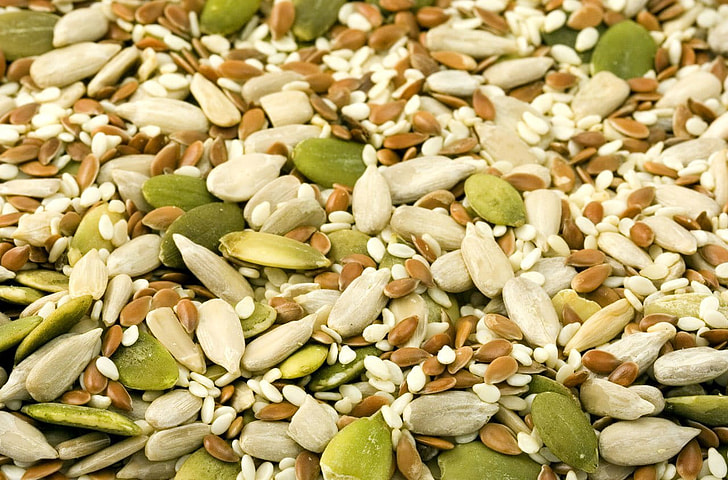
What is seed cycling?
Seed cycling is the practice of eating specific, nutrient dense seeds throughout your menstrual cycle to promote a healthy balance of estrogen and progesterone to improve menstrual and reproductive health as well as support your gut microbiome. Seed cycling can be beneficial for those managing PMOS/PCOS, endometriosis, PMS, menopause and perimenopause symptoms, and supports fertility.
How to get started:
Seed cycling rotates 4 seed types across the two main phases of the menstrual cycle. The follicular phase (pre-ovulation) and the luteal phase (post-ovulation).
Follicular Phase: Days 1-14:
Starting from the first day of your menstrual cycle until ovulation (roughly 14 days) eat 1 tablespoon ground flax seeds and 1 tablespoon pumpkin seeds daily.
Luteal Phase: Days 15-28:
From ovulation until your next period, eat 1 tablespoon sunflower seeds and 1 tablespoon sesame seeds daily.
Even if your cycle is not exactly 28 days or if you do not have a period regularly, sticking with the 28 day schedule is a simple way to stay on track and stay consistent to get the most benefit. One way to do this is to follow the lunar cycle: Days 1-14 from new moon to full moon, Days 15-28 from full moon to new moon. This is a consistent schedule that can help you stay on track with seed cycling.
The benefits of seed cycling:
Research has shown that seed cycling has a promising outcome on the LH:FSH ratio and total testosterone levels in addition to several other benefits due to the abundance of vitamins and nutrients they contain.
- Pumpkin Seeds are a powerhouse of nutrients, they are rich in antioxidants, zinc, iron, and magnesium.
- Flax seeds contain omega-3s, vitamin B, minerals like copper, magnesium, and zinc, as well as lignans which interact with estrogen receptors.
- Sunflower seeds contain vitamin E and selenium, which have been shown to lower cholesterol and blood pressure, as well as promoting the production of progesterone.
- Sesame seeds have vitamin E, B6, selenium, iron, and also contain lignans to help block excess estrogen while progesterone rises.
In the first two weeks of your cycle, pumpkin and flax seeds aim to increase estrogen while also preventing excess estrogen. The second pair helps to increase progesterone production. An easy way to incorporate these seeds daily is by adding them to your oatmeal or yogurt, blending them into a smoothie or protein shake, or sprinkling them on top of soups or salads.
Tips for success!
- Use raw seeds: Raw seeds are best to ensure they contain all the nutrients that can be lost in the roasting process.
- Store them properly: Keep seeds in the fridge or freezer to prevent the seed oils oxidizing and going rancid.
- Grind your seeds: This is especially important for flax seeds which need to be ground in order to be properly absorbed and digested. You can easily grind your seeds with a coffee or spice grinder before adding them to your plate!